


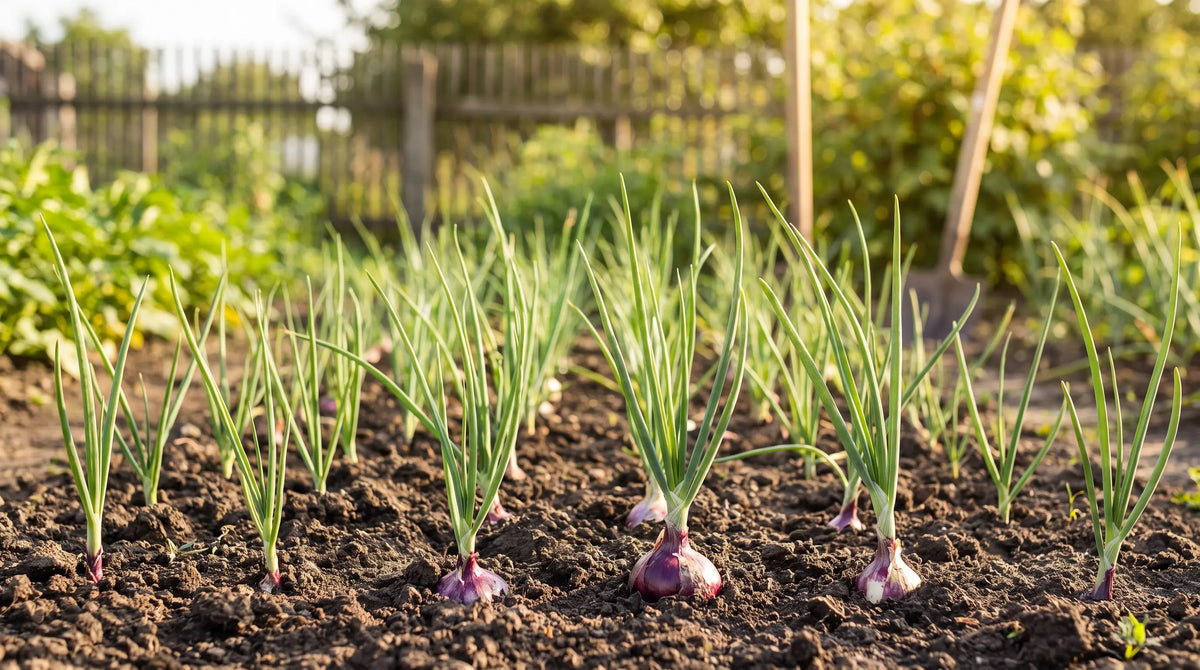
When to Plant Onions for Big, Long-Storing Bulbs
Updated October 2026
You planted onions last year and pulled up a handful of golf balls. It happens to careful gardeners all the time, and it almost always traces back to one thing: timing. An onion counts daylight, not weeks on the calendar, to decide when it quits making leaves and starts swelling a bulb. Plant so the plant is broad and leafy before that switch flips, and you pull fat, heavy bulbs that keep for months. Get the timing wrong and the very same seed hands you those golf balls.
Onions read the calendar and the clock
An onion spends the first half of its life making leaves and the second half pouring that growth into a bulb. Every leaf feeds one ring, so a plant carrying a dozen thick tops has the makings of a heavy, many-layered onion underneath. Here is what trips people up: the plant stops making new leaves the moment bulbing begins, and that switch is thrown by day length, not by how big the plant happens to be. Whatever tops it has when the days grow long is all it gets to build with.

That is why two gardeners can sow the same seed and pull very different harvests. One grew a broad, leafy plant before the long days arrived. The other planted late, and the bulbing signal flipped while the plant was still thin, leaving only a few small rings to swell.
Match the onion to your latitude
Onions are sorted by the day length that triggers them, and matching that to where you garden is the biggest lever you have. Long-day onions wait until daylight stretches to roughly 14 to 16 hours before they bulb, which suits the northern half of the country. Short-day onions flip at around 10 to 12 hours and are built for the South, sizing up over a mild winter before the heat. Intermediate types cover the middle of the country. Plant a short-day onion up North and it bulbs before it ever grows big; plant a long-day type in the Deep South and the days may never get long enough to trigger it at all.
Up North, a long-day sweet onion like Walla Walla is the classic pick. Sweet onions run high in water and low in the sulfur that makes an onion sharp, so they are glorious sliced fresh but not built to store.
Sale

Walla Walla Onion Seeds – Non-GMO HeirloomLong-day sweetA famously sweet, mild long-day onion for northern gardens. High in water and low in sulfur, so it is best sliced fresh through summer rather than stored long. Non-GMO heirloom seed.
Price$5.99
Sale Price$4.99
Southern gardeners do best with short-day varieties. A mild red such as Red Burgundy colors up deep through the rings and eats sweet, raw in salads or blistered on the grill.
Sale

Red Burgundy Onion Seeds – Non-GMO HeirloomShort-day redA short-day red with a gentle, sweet bite and color that runs deep through every ring. Perfect raw in salads or blistered on the grill for Southern gardens. Non-GMO heirloom.
Price$5.49
Sale Price$4.99
For a main crop that actually keeps in the North, a long-day Spanish type gives you big globes with a gentler bite and skins firm enough to hold for a few months in the pantry.

Utah Yellow Sweet Spanish Onion Seeds – Non-GMO HeirloomLong-day storageLarge, all-purpose long-day globes with a mild flavor and skins firm enough to keep a few months. A dependable main-crop onion for the North. Non-GMO heirloom.
Price$4.99
| Variety | Day length | Best region | Flavor and keeping |
|---|---|---|---|
| Walla Walla | Long-day | North | Sweet, mild, eat fresh |
| Red Burgundy | Short-day | South | Mild red, best raw |
| Utah Yellow Sweet Spanish | Long-day | North | Large, all-purpose, keeps a few months |
When to start onion seeds
Onion seed is slow off the mark, so it earns a head start indoors. In most northern gardens, sow 8 to 10 weeks before your last spring frost, usually in late winter. Keep the seedlings under strong light, or weak light gives you thin, floppy threads instead of sturdy plants. When the tops reach four or five inches, trim them back to a couple of inches with scissors. That haircut looks harsh, but it pushes the plant to thicken its stem and roots instead of toppling over, and you can repeat it once or twice before transplanting. Harden them off before they move outside.
Set transplants out 4 to 6 weeks before your last frost, about as thick as a pencil. Young onions are tough and actually want cool weather for building leaves, so an early start means more tops before the heat of summer. One catch is worth knowing: a plant that meets a long cold spell already thicker than a pencil can read that cold as a full winter and bolt to flower in spring, which hollows the bulb and ruins its keeping, so do not start seed too early or set out oversized plants. Set them shallow, with the little bulb near the surface where it can spread. You can also direct sow once the soil can be worked, though those bulbs tend to run smaller. In the mild-winter South, short-day onions go in the ground in fall and grow through winter for an early-summer harvest.
Feed the tops to grow the bulb
Every leaf becomes a ring, so your one job in spring is to grow the biggest, greenest plant you can before the days go long. Onions have skimpy, shallow roots and lose badly to weeds, so keep the bed clean and pull by hand rather than tearing those roots with a hoe. Water steadily, since onions that dry out and then flood tend to split or throw a second bulb. Feed a nitrogen-rich fertilizer every couple of weeks while the tops climb, then cut it off the moment the bulbs begin to swell. Late nitrogen breeds thick, soft necks that refuse to cure and rot first in storage, which is exactly what you are trying to avoid. Give each plant about four inches of room to fatten, because crowded onions stay small.
Harvest and cure for long storage
When about half the tops soften and topple on their own, the bulbs are done growing. Resist the urge to knock the rest down by hand, since a bruised neck is an open door for rot. Stop watering, let the bulbs firm up in the ground for a few days, then lift them on a dry morning and brush off the loose soil without washing them.
Curing is what separates an onion that mushes in a month from one that carries you through winter. Spread the bulbs in a single layer somewhere warm, dry, and airy, out of direct sun so they do not scald, until the necks are papery and the skins rustle, usually two to three weeks. Trim the tops to about an inch, then store them cool and dark. Set aside any onion with a thick, soft neck to eat first, because those never keep. Sweet types like Walla Walla are best within a few weeks, while sharp, well-cured yellows are the ones that hang on for months.
Frequently asked questions
When is the best time to plant onions?
In most northern gardens, start onion seeds indoors 8 to 10 weeks before your last frost, then set transplants out 4 to 6 weeks before it, while they are still pencil thick. That early start builds the big, leafy plants that turn into large bulbs. In the mild South, plant short-day onions in fall.
What is the difference between long-day and short-day onions?
Long-day onions bulb once daylight reaches about 14 to 16 hours, so they belong up North with long summer days. Short-day onions flip at 10 to 12 hours and suit the South, sizing up over winter. Match the type to your latitude, or the onion bulbs too soon or never bulbs at all.
Can you grow onions from seed instead of sets?
Yes, and for big keepers, seed beats sets. Sets are last year's baby onions, so they bolt more readily. Seed gives you far more varieties plus cleaner, longer-storing bulbs that bolt less. The trade is patience: sow indoors in late winter, since the seed is slow, then transplant early.
Why are my onions so small?
Small onions usually mean the bulbing signal arrived before the plant grew enough leaves, leaving only a few rings to swell. Fix it by planting early, matching the day-length type to your region, keeping the bed weeded and evenly watered, and feeding the tops. Crowding stunts them too.
How do I store onions so they last?
Harvest when the tops fall and yellow on their own, then cure the bulbs in a single layer somewhere warm, dry, and airy, out of direct sun, for two to three weeks, until the necks are papery. Store the well-cured onions cool and dark, and eat any thick-necked ones first.

- Choosing a selection results in a full page refresh.









 Easy Returns 30-day guarantee