


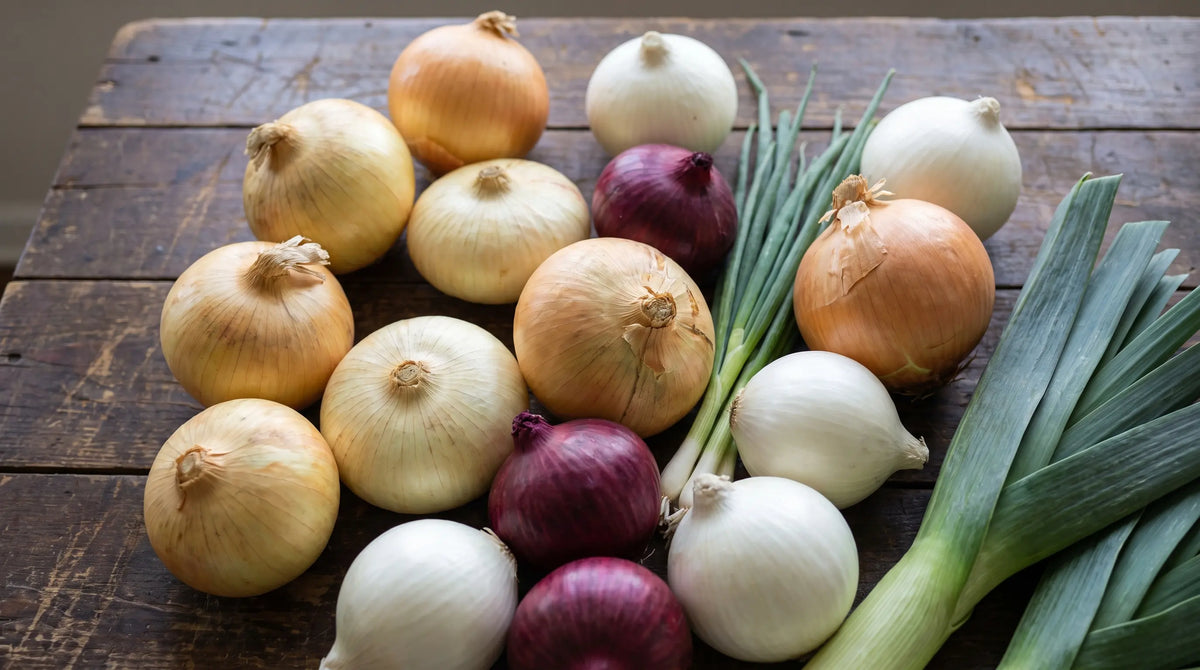
Types of Onions: A Complete Guide to Every Variety (Chart Included)
Updated August 2026
Not every onion grows everywhere, and no single onion does every job. Choosing the right one comes down to two questions. First, where you garden, because that decides whether a bulb ever forms. Second, how you want to use it, whether that is long storage, fresh summer eating, or a steady supply of green tops. Sort your options by those two things and the choice gets easy. When your bulbs are grown and you need to know the moment to pull them, our guide on when to harvest onions covers that side.
Day length: what decides whether an onion bulbs
Onions start forming a bulb only when the days reach a certain length, so the type has to match your latitude. Plant the wrong one and you get plenty of leaves but never a real bulb. There are three groups. Long-day onions bulb when days stretch to about 14 to 16 hours, and they do best in the northern half of the country, planted in early spring. Most classic storage onions are long-day types. Short-day onions bulb at about 10 to 12 hours and suit the South, where they go in during fall or late winter for an early-summer crop. Intermediate onions, sometimes called day-neutral, bulb in between and grow well across the middle of the country, which makes them the safe pick if you are not sure of your zone.
By use: storage, sweet, and green
Once you have matched day length to your region, choose by how you cook. That is where most of the decision really happens.

Storage onions
These are the firm, pungent, thick-skinned onions, mostly yellows and many reds. That sharper bite comes with a real payoff: well-cured storage onions keep for months, often deep into winter. They are the everyday workhorse of the kitchen.
Sweet onions
Sweet onions like Walla Walla hold more water and sugar and far less bite, mild enough to slice thin onto a sandwich. The trade-off is shelf life. They are thin-skinned and juicy, so they bruise easily and last only a few weeks. Grow them to eat fresh through summer, not to store.

Utah Yellow Sweet Spanish Onion Seeds – Non-GMO HeirloomLong-day storageLarge, mild long-day yellow bulbs that cure and store for months, the all-purpose kitchen onion.
Price$4.99
Sale

Walla Walla Onion Seeds – Non-GMO HeirloomSweet, fresh-eatingThe classic Pacific Northwest sweet onion; ultra-mild and best eaten fresh within weeks of harvest.
Price$5.99
Sale Price$4.99
Green and bunching onions
Green onions, also called scallions, and true bunching onions are grown for their tender stalks instead of a bulb. They come up fast, do not mind a little crowding, and can be sown every few weeks for a steady supply of tops all season.
Sale

Green Onion Seeds – Tokyo Long White, Non-GMO HeirloomBunching / scallionsTokyo Long White bunching onion for scallions and green tops; sow in succession all season.
Price$4.99Starting at$3.99
Yellow onions, the everyday all-rounder
Yellow onions are the default for good reason. Their flavor is balanced raw and turns rich and mellow once cooked. The Sweet Spanish group, including the Utah strains, grows large, round, straw-colored bulbs that are mild for a storage onion and cure well for months. They are long-day types and a northern-garden staple, and they usually take about 100 to 120 days to mature.
Sweet, red, and white onions
Walla Walla is the classic sweet onion: big, flattened, pale, and famously mild, a long-day variety best started early in the North. Red onions such as Red Burgundy bring purple-red color and a mild, sweet flavor to salads and the grill, though they only keep moderately well. On the white side, Sweet Spanish whites give clean, mild bulbs, and the Grano types behind Vidalia-style onions are sweet, short-day onions bred for the South. As a rule, the milder and juicier the onion, the sooner you should use it.
Green onions and leeks
Not every allium makes a bulb. Bunching onions like Tokyo Long White grow long white shanks and green tops, ready in about 60 to 75 days and good to pull young as scallions. Leeks are an onion cousin that forms a thick, mild stalk instead of a bulb. They are slow, close to 100 to 120 days, but cold-hardy enough to stand in the garden well into fall. Both more or less ignore day length, since you harvest the whole plant rather than waiting on a bulb.
The onion chart
| Type | Day length | Examples | How long it keeps |
|---|---|---|---|
| Yellow storage | Long day | Yellow Sweet Spanish, Utah | Several months |
| Sweet | Long day | Walla Walla | A few weeks |
| Red | Short to intermediate | Red Burgundy | 1 to 2 months |
| White | Long or short | White Sweet Spanish, Grano | Weeks to a couple of months |
| Green / bunching | Day neutral | Tokyo Long White | Use fresh |
| Leek | Day neutral | American Flag | Stands in the garden into fall |
Which onion should you grow?
Start with geography, because nothing else matters if the bulb never forms: match long, short, or intermediate day to your latitude. Then pick by use. A pungent yellow for the pantry, a Walla Walla or a sweet white for summer eating, and a row of bunching onions for green tops all season is a good spread. If you want to cover every base from one sowing, a mixed pack is the simplest way to do it. Once they are in the ground, our guide to when to harvest onions walks you through reading the tops and curing for storage.
Related guides
Frequently asked questions
What are the main types of onions?
Onions sort two ways: by day-length (long-day, short-day, and intermediate or day-neutral, which controls where they bulb) and by use (pungent storage onions, mild sweet onions, and non-bulbing green or bunching onions). Leeks are a close allium cousin.
What is the difference between long-day and short-day onions?
Long-day onions bulb when daylight reaches about 14 to 16 hours, so they suit the northern U.S. Short-day onions bulb at roughly 10 to 12 hours and suit the South. Plant the wrong type for your latitude and the plant makes leaves but never forms a proper bulb.
Which onions store the longest?
Pungent yellow storage onions and many reds keep best; thick skins and higher sulfur content let well-cured bulbs last several months, often into winter. Sweet onions like Walla Walla hold far more water, so they bruise easily and last only a few weeks.
What is the difference between green onions, scallions, and bunching onions?
Green onions and scallions are the same thing: young onions pulled for their stalks before a bulb forms. True bunching onions (Allium fistulosum), like Tokyo Long White, are a non-bulbing species grown specifically for those slender white shanks and green tops.
Are onions and leeks the same plant?
No. Leeks (Allium ampeloprosum) are an onion cousin that forms a thick, mild stalk instead of a bulb. They take longer to mature, around 100 to 120 days, but are very cold-hardy and can stand in the garden well into fall for a late harvest.

- Choosing a selection results in a full page refresh.









 Easy Returns 30-day guarantee